Metaphors, ways of thinking of one thing in terms of another, can reveal, inspire, and mask. There’s no “literal” unmediated depiction of reality, as Locke, Derrida, George Lakoff, and other philosophers have shown. I wrote my Master’s thesis on metaphors in the Chinese text Zhuangzi and talked about how these revealed some of the ways of thinking of the philosopher, with the emphasis on movement. Even so-called objective science uses human-created categories, as philosophers of science—though maybe not those with a simplified scientistic view—know. This might be called a nominalist versus a realist perspective. We see this in politics, art, literature, morality, and theology. Whether we call God a father or a parent or a force, a friend or a judge or an artist, a he or she or they or it, we have different relationships to that system of theology, and many theologians discuss this, not only in terms of translation but in terms of the entailments of one form or another. The human-like Greek gods versus the multifaceted Hindu gods versus the ancestral Chinese gods ... these all have different implications.
Ways of thinking of time, or the mind, or the body—as cycle or clock, as container or computer, as machine or computer—influence the ways we think about the world.
Metaphors for school have abounded, as I wrote in an old 2018 post that I rediscovered and finally posted on Substack last week. Whether schools are factories or gardens or sandboxes or oases or homes, each will have a different set of experiences. Whether teachers are parents or judges or coaches, whether students are colleagues or scholars or subjects, all of these have entailments, and we are often unaware or unconscious of how they dominate our thinking. We see it in the architecture and the conversational interactions and the clothing.
And ideas about change—teleological (goal-oriented), degenerative, inevitable, dangerous, necessary, natural, difficult—are also influential. The history of science and the field of intellectual history have grappled with this for centuries. I just want to present a case, reporting back from the field (in this case, from a conference), and to think with it. What is a useful way to conceptualize educational change?
Last week I had the great pleasure of attending the eighth incarnation of The Grading Conference. (Full disclosure: I attended as much of it as I could, but I had some other obligations and, honestly, on Thursday afternoon I had to—emotionally had to—watch the livestream of the opening of the Obama Presidential Center.)
The conference had begun when Sharona Krinsky, Robert Bosley, and several other math educators got together to talk about shortcomings in the grading system. Their conversation grew and included more people, not just mathematicians, and it became a robust place for thinking about what might be called alternative assessment. They offered a free conference for a while, beginning in 2020, then called Mastery Grading Conference, but then established a non-profit called The Center for Grading Reform which puts on low-cost conferences. They do amazing inclusive work. (They have a podcast with 153 episodes, and counting, just since it launched in 2023.)
Different audiences and different purposes may demand different ways of addressing any topic, which may in part account for why terminology for a certain phenomenon is, and must be, unstable. Rhetoric scholars remind us that there is always a “rhetorical situation,” and that the writing or speaking must suit that.
A graduate student once asked me, “When I am applying for academic jobs, should I state that I use ungrading?” I suggested that this term is unfamiliar and may trigger alarm, so it might be better, but still honest, to say things like “I emphasize student-centered assessment and feedback-rich interactions, and active learning.”
“Grading reform” clearly aims to be a broad tent (I’ve called it “the ungrading umbrella” which is obviously not the term that the field is choosing), and possibly unthreatening. Who doesn’t want a little reform?
But more important, the existence of such a conference reflects the fact that people recognize that conventional systems of grading, perhaps one-off tests averaged into other assessments or conflation of behavior/compliance (following directions) and learning of material, is not working.
What it means to “not work” is a matter of discussion, though not for this already-long piece.
(I often talk about the fact that grades fail to motivate in positive ways and they are very poor at providing useful information, whether it’s feedback for the student or a communication about what the student can do.)
There is also instability about whether by assessment we mean the artifact, such as the test, or the process of assessing, which can sometimes be done as simply as noting that students light up when a certain concept is discussed, or whether it is the final artifact that is the summation of the learning. People distinguish formative and summative assessment. Even if experts on assessment try to force agreement about the terms, educators are an unruly bunch. There’s a journal, Assessment and Evaluation in Higher Education, which can provide some sense of the scope of the topic.
Perhaps it is widespread dissatisfaction with the status quo that requires “reform”—a relatively nonthreatening term. Many, if not most, faculty feel vulnerable and afraid as they try to introduce practices that are novel, but they find courage through events such as this conference and solidarity with others similarly trying new approaches, especially if they are mere “reform” or “alternative.”
At The Grading Conference, with its practical reporting on implementation, its careful research done in various courses and using varied methods, its keynotes reminding us of student differences and needs and tastes—perhaps a menu of choices—we got a sense of the lack of agreement, lack of shared meaning, lack of shared goals, lack of shared values. Do we call it grading or assessment or marking, alternative or reform, ungrading or any of the specific variants, such as standards-based grading or mastery grading or specifications grading or labor-based grading or contract grading or collaborative grading? How to decide?
Here are the terms used in titles for the presentations in 2026, some many times and some only once:
alternative grading
standards-based grading
specifications grading
student assessment
mastery-based grading
threshold grading
point-free mastery-based grading
feedback
ungrading and un-grading
grading innovations
cumulative- and mastery-based grading
retesting without penalty
holistic grading
completion-based grading
grading for accuracy
equitable grading
contract grading
project- based grading
self-graded homework
helpful feedback
collaborative grading
In one talk, someone casually mentioned (I’m sorry but I don’t remember who) that maybe in the future, we’ll just talk about “grading” and mean all of it. (I’d rather we not talk about grading at all….but I digress.)
But in addition to the specifics of the discussion, I just want to point out that the conversation has attracted hundreds if not thousands of participants, who work throughout the world in every possible identity and position and ability; in every possible subject, department, discipline; in every possible role from graduate student to adjunct to full professor; and in every possible institution from community college through regional public universities to the most elite institutions.
Still, and useful for our consideration, at the same time that this conversation is happening, a parallel conversation is happening about so-called grade inflation (Is it in fact a problem?) and restoring a limited bestowal of “high grades” (which means A’s at elite schools like Harvard and Yale), returning to grading on a curve, to emphasize the sorting dimension of grading, which all the rest of us are trying to minimize.
This disagreement, in a nutshell, indicates the profound disagreement about almost every dimension of grading/assessment in education, which in turn points to disagreement about the purpose of education.
Some of the specifics include the question of: For whose benefit is the grade? Is it for the benefit of employers and providers of internships and entry into further levels of education? That is certainly an actual use of this information, of these metrics, and as we all know, metrics become the goal when they are widespread, in what is sometimes called Goodhart’s Law.
Are grades good for students? Do they force them to work better? Do they incentivize cheating? Do they produce anxiety and harm mental health? Research, student reports, evidence I heard at the conference consistently (but not universally) suggests no, no, yes and yes.
Education, especially mass education, has attracted enormous dissent because it embeds theories of society and humankind, values of thriving (cooperation or competition?). Such questions can’t be settled by technocratic research. Tests might give information about certain dimensions of learning (See Gert Biesta on “learnification”) but are there other less tangible goals as well? How do we measure joy?
Earnest disagreement about methods and purposes means that easy implementation might occur without even stretching the expectations, but should it?
This is a domain ripe for….schism? Collapse? Given the current realities, can each of us just reform our way to the promised land?
I’m writing something longer (maybe a book?) to engage more deeply and fully with the instability of the whole enterprise, revealed by the sudden descent of AI into what was already a troubled region.
But right now I want to raise the question of what metaphor of change we can discern from this one event: What is change in education?
Change in education has been conceived of in various ways.
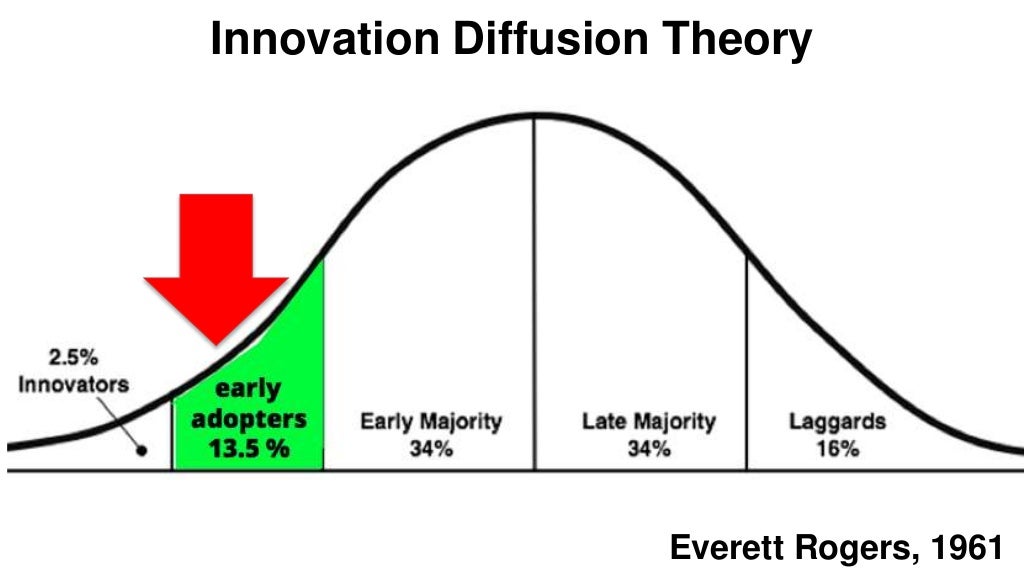
Like other domains, change in education has sometimes been conceptualized as a linear process like the theory of diffusion of innovation from Everett Rogers.
Is the notion of alternative assessment, ungrading, and all the variants, an “innovation” working its way through the sector, with a few innovators, speaking in early years to the “early adopters,” and now to more people? What about those who resist? Who fully dissent? “Laggard” doesn’t seem to apply completely.
I have often conceived of change in education in terms of paradigm shift in Thomas Kuhn’s sense.
Kuhn, who wrote about scientific revolutions, argued that there was a period of instability when multiple paradigms were being proposed to account for anomalies in observation and evidence, after which a new explanation settled down and became what he calls normal science again, but a different version. We observe this in theories of astronomy, geology, genetics.
If everyone stopped using conventional grades, this might indicate a paradigm shift.
In terms of education, we can think about evolution and revolution. In my own two-decade journey rethinking education, I have been on the side of revolution, or what one of my graduate students called “burning it all down,” at the same time that I have continued to engage in evolutionary practice. Alfie Kohn talks about this functioning at two different levels, a gradual and a sudden level. There is a whole category of people that we might call faculty development or instructional designers who are trying to work within the actual system we have and make it work better, for instance by figuring out a way to hack the learning management system such as Canvas to work with alternative grading systems such as standards-based grading, which tends to be about points, rather than letter grades. Many faculty have no power to change the system, but must operate within it. How do we use the tools available to reach a different end?
And would this bring about systemic change, or merely allow it to endure?
The final metaphor I want to talk about today is hacking.
In the 2010s, a series of books, Times 10 publications, used the notion of hacking as a way of suggesting change in K/12 education. in a series called “Hack Learning” (titles include Hacking Education, Hacking Instructional Design, Hacking Engagement, etc.)
The Hack Learning Series explains itself:
“In 2014, Times 10 publisher Mark Barnes had an idea about three big problems in schools that he felt could be easily fixed. What they needed was the perspective of a hacker—someone who viewed its underlying issues through a different lens. Mark wrote a short blog post identifying three problems and included a few very easy fixes.
“The post sparked thoughtful discussion, and readers suggested that schools have more concerns like the ones in the blog post—enough perhaps for a book.
“Some time later, one short blog post turned into the first book in the Hack Learning Series, Hacking Education: 10 Quick Fixes for Every School. #HackLearning: It’s What You Can Do Tomorrow.”
I have not read all the books in that series, but one that I discovered in 2016 really influenced me—nay changed my life—when I encountered it: Starr Sackstein’s book Hacking Assessment: 10 Ways to Go Gradeless in a Traditional Grades School. This gave me the courage to begin to implement what I called ungrading in my own classes, in a conventional education system. (I am delighted to have contributed a short section in the second edition, published in 2022.) (The series now has an “AI Coach”….things change.)
The question I would like to engage with here, though, taking a lay person’s understanding of what hacking means, is when does the hacking break the system?
When do the “easy fixes” end up leading to further changes? How many does it take?
How far can faculty go with alternative grading or assessment and still function within the system?
How much inconsistency can operate within the system and still represent it as a single system?
When does the elasticity end and the rubber band breaks?
What is the best fitting metaphor for change in education?
Earthquake?
Tsunami?
Collapse?
A hack?
Development?
Normal scientific development?
Abandonment?
Revision?
Reform?
Does the current system endure, muddle along, or does something else emerge? What forces push it to change? Is there violence along the way?
Will it snap?
What do you think? And why?